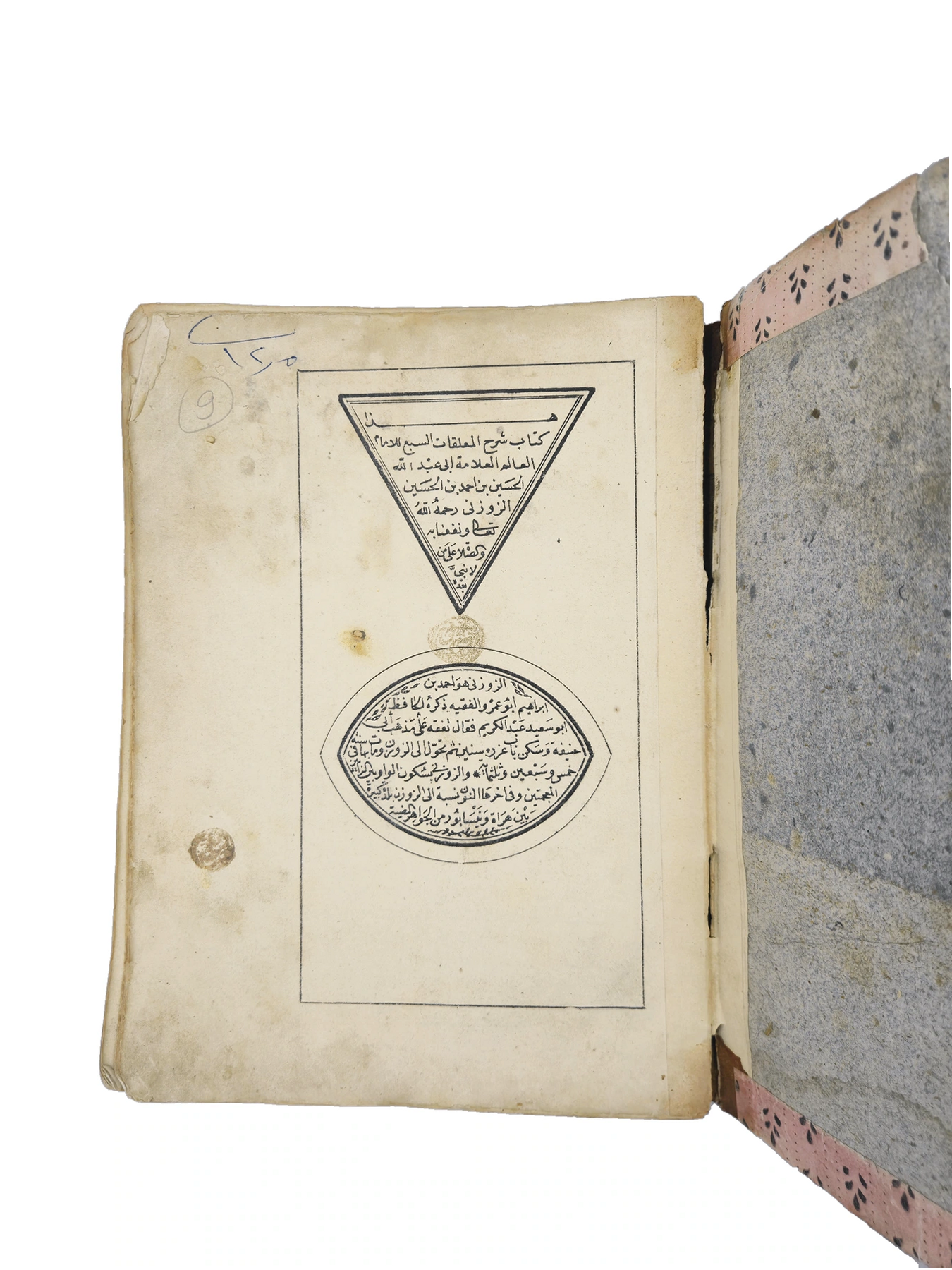
Title page with oval biography and stamps of al-Zawzanī’s commentary on the seven Muʿallaqāt.

Art & History on Paper · October 2026

Printing
in Egypt

Expedition presses, Būlāq and the literary book

The catalogue

From state presses to a plural publishing culture

Egypt played a formative role in the printed culture of the Arab world. The fourteen objects in this catalogue, dating from 1798 to 1876, illuminate a changing relationship between print, power and scholarly initiative: the presses of a foreign occupation, the state enterprise at Būlāq, and an increasingly varied world of commercial printers and learned publishers. Read together, their imprints reveal how the means of bringing knowledge into print came to involve a wider range of participants.

Read the introduction

The French expedition papers of 1798–1801 belong to the first of these settings. A newspaper, official reports and an order of the day place printing within the demands of military occupation, administration and public persuasion. The Maltese capitulation provides a prelude along the expedition’s route. These documents preserve a distinct colonial episode, in which the press helped an occupying power communicate its authority.

Būlāq, established under Muḥammad ʿAlī and commemorated by a foundation plaque dated 1820, served a later programme of Egyptian state-building within an Ottoman political world. Its early work supplied the army, schools and administration with translated knowledge. The Ottoman Turkish naval manual in this catalogue embodies that purpose through its text and technical illustrations. Poetry and correspondence in Turkish, together with Saʿdī’s Persian Gulistān, also reveal the literary cultivation of this multilingual environment. A state press could serve both practical instruction and learned taste.

By the middle decades of the century, private enterprises were becoming significant producers of Arabic books. The Kāstiliyya press, founded in Cairo by the Italian Jewish printer Mosè (Mūsā) Castelli in the early 1850s, connected commercial initiative with the expertise of Muslim scholars. Its 1876 edition of al-Shabrāwī’s Dīwān places the poetry of a former head of al-Azhar within this cosmopolitan book trade. Commissioned editions enabled individuals to choose works for publication, while requiring them to bear substantial financial risk.

Other imprints reveal different ways of making and financing books. Al-Zawzanī’s commentary on the seven odes was lithographed in 1860 at the Maṭbaʿat al-Ḥajar al-Bāhira, managed by Maḥmūd Efendi, a Maltese stationer in Khān al-Khalīlī. Ibn Khafāja’s Dīwān, published in 1869 by the press of the Jamʿīyat al-Maʿārif, represents collective learned enterprise. Founded the previous year, the society brought members’ financial contributions together with editorial selection and preferential access to its publications. Alongside the state establishment, workshop, commercial commission and scholarly association each offered a route into print.

This diversification grew through continuing relationships between printers, scholars and institutions. Būlāq and private presses shared expertise; Naṣr al-Hūrīnī’s work as a corrector connected state employment with commercial editions. Manuscripts supplied texts and informed the visual arrangements of printed books, while Cairo’s printers drew on skills and models circulating through Istanbul and other centres. Participation in publishing widened, but it remained shaped by capital, scholarly authority and access to technical resources. The surviving books reveal these networks more readily than they establish the social breadth of their readership.

The catalogue thus traces overlapping forms of authority and enterprise through the material evidence of books. Military information, translated science and the recovery of classical literature belong to this history together. Their typography, decoration, editorial labour and signs of use give tangible form to Egypt’s emergence as a publishing centre whose influence reached far beyond its borders.

Fourteen objects

Contents

Part I

Būlāq and the literary book

01

Pertev’s Dîvân from the literary circle of Hoca Neş’et

Muhammed Pertev known as Muvakkitzâde (1746–1807/08)

Dîvân-ı Pertev

Būlāq, Cairo: Būlāq Press, 5 Ṣafar 1253 AH [11 May 1837].

View on Artem Rare Books

25 × 17 cm. 91 pp. Ottoman Turkish poetry, in ruled compartments with an ornamental opening; terminal colophon on page 91.

Muted red cloth-covered boards.

Manuscript numerals and pencil marks on the preliminary leaf.

A Būlāq edition of the Dîvân of Muvakkitzâde Muhammed Pertev, a poet associated with the literary circle of Hoca Neş’et. That circle also included Şeyh Gâlib and occupied an important place in late eighteenth-century Ottoman poetry. Pertev’s verse belongs to this setting of cultivated literary exchange; his career also extended to official historical writing.

Ekrem Bektaş identifies the Būlāq printing of 5 Ṣafar 1253, or 11 May 1837, as the work of Muvakkitzâde, rather than the similarly named statesman Pertev Pasha. The colophon on page 91 dates the printing to 5 Ṣafar 1253 AH. Its ornamented opening and framed verse carry an Ottoman poetic collection into an Egyptian printed form.

Murat Sivri’s 2024 study offers another way into Pertev’s verse: the night as a setting for solitude, longing and imagined reunion. Celestial imagery also intersects with the language of timekeeping, a suggestive connection for the son of the timekeeper at Istanbul’s Sultanahmet mosque. The poems bring emotional experience and the observation of time into the same imaginative world.

Condition

Binding rubbed and faded; scattered foxing and marginal soiling, with creased corners and dampstaining to the final leaf.

References

Bibliographical sources
02

The Turkish and Persian poetry of an Ottoman court historian

Mustafa Sâmî Arpaemînizâde (d. 1734)

Dîvân-ı Sâmî

Būlāq, Cairo: Maṭbaʿat Ṣāḥib al-Saʿāda al-Abadiyya, late Rabīʿ al-ākhir 1253 AH [1837].

View on Artem Rare Books

25 × 17 cm. Three separately paginated divisions: 104, 47 and 67 pp. Ottoman Turkish text, with Persian poems. Ruled verse compartments and ornamental section headings.

Brown quarter-leather over marbled-paper boards; yellow endpapers.

Blue ink ownership stamp and a magenta manuscript mark at the front; manuscript annotations, including an entry on the rear endpaper.

A Būlāq printing of the verse of Mustafa Sâmî, an Ottoman administrator, calligrapher and official chronicler. His bureaucratic career culminated in service as court historiographer under Mahmud I. The Dîvân represents another aspect of that career: a cultivated literary language in which poetic address, reflection and the commemoration of events drew upon a shared Persianate vocabulary.

Sâmî’s work is associated with the elaborate imagery and intellectual compression of the style known as Sebk-i Hindî. His poetry responds to earlier Turkish and Persian poets while pursuing demanding combinations of image and meaning. Fatma Sabiha Kutlar Oğuz places him between Nâʾilî and Şeyh Gâlib, and notes his influence on later writers including Namık Kemal. The Būlāq edition carried this early eighteenth-century poetic inheritance into a new nineteenth-century printed form.

The final colophon names Būlāq and late Rabīʿ al-ākhir 1253 AH. Ruled verse and decorated headings organise poems and larger divisions, carrying established conventions of literary reading into print. Research on Ottoman typography places such books within a wider negotiation between calligraphic models and typographic production. This copy’s ownership marks and manuscript entries record subsequent use, although their authors remain unidentified.

Condition

Binding worn; scattered spotting and dampstaining, extending into the text on the final leaves, with minor corner losses.

References

Bibliographical sources
03

Ottoman education in verse: Vehbî’s Dîvân with the Lutfiyye

Mehmed Sünbülzâde Vehbî (d. 1809)

Dîvân-ı Vehbî, with Lutfiyye-i Vehbî

Būlāq, Cairo: Maṭbaʿat Ṣāḥib al-Saʿāda al-Abadiyya, 1253 AH [1837].

View on Artem Rare Books

25 × 17 cm. Seven separately paginated sections in one volume: 20, 17, 43, 131, 16, 97 and 61 pp. Ottoman Turkish, with Arabic and Persian sections. Ornamental headings and ruled verse compartments.

Dark cloth-covered boards with a dark leather spine. Orange-and-cream geometric patterned endpapers; manuscript title on the fore-edge.

Manuscript notes, shelf numbers and ink seals on the preliminary leaves.

This substantial Būlāq volume brings together the multilingual poetry of Vehbî and the Lutfiyye, his verse advice to his son Lutfullah. Its separately paginated divisions encompass an introductory section, an Arabic poem responding to the celebrated Burda, Persian verse, Ottoman Turkish qaṣīdas, chronograms and ghazals, followed by the Lutfiyye. It makes visible the movement between Arabic, Persian and Turkish within Ottoman literary culture.

Vehbî combined poetry with service as a judge and diplomat, including an embassy to Karim Khan Zand in 1775. His Lutfiyye offers selective advice on education: a 2025 study by Sinan Urhan and Ayşe Farsakoğlu Eroğlu draws attention to its praise of logic alongside reservations about geometry and other pursuits. The printed Dîvân omits poems found in manuscripts; it is not an exhaustive collection.

An inscription on the patterned endpaper labels the volume no. 214 and attributes it to the books of Grand Vizier Said Pasha, followed by “İstanbul Nişantaşı 1914”. The attribution to Said Pasha is unconfirmed; the writer, date of the inscription and accompanying seals remain unidentified.

Condition

Binding rubbed, with a weakened, repaired opening joint and gutter tears; marginal dampstaining and small losses to the preliminary leaves.

References

Bibliographical sources
04

Navigation, astronomy and the Būlāq translation programme

Antoine; translated into Ottoman Turkish by Mehmed Mustafa Tercüman

Mecmûa-i fennü’l-bahriye [Compendium of Naval Science]. Volume I, parts 1–5

Būlāq, Cairo: Dâr al-Tibâʿa al-ʿĀmira (Būlāq Press), 1254 AH [1838].

View on Artem Rare Books

Five parts in one volume, with preliminary matter and ten folding lithographed plates recorded for this copy. Ottoman Turkish in Arabic script, with ornamental openings, ruled text borders, numerical tables and diagrams. Dimensions recorded in the earlier copy description: approximately 30.5 × 20 cm.

Green leather binding with a small gilt floral ornament and blind decoration; yellow edges. The leather is rubbed and scuffed, particularly at the corners and joints. Pastedowns browned and stained, with Ottoman Turkish manuscript ownership entries; the earlier copy description records missing free endpapers and a partly loose first leaf. The photographed text is generally clear, with occasional spotting and marginal soiling. Folding plates are creased along the folds, with uneven edges, some marginal browning and small edge tears.

An Ottoman Turkish compendium of navigation printed in Cairo during the expansion of technical instruction under Muḥammad ʿAlī. Istanbul University catalogues the work under Antoine and identifies Mehmed Mustafa Tercüman as its translator from French. The present volume contains the first five parts: it is the first volume of a work for which a separate second volume is also documented.

The opening proceeds from the principles of navigation to the mathematical knowledge needed to determine a vessel’s course and position. Text, worked calculations and tables are accompanied by folding plates of geometrical constructions, celestial circles and navigational instruments. Among the plates photographed in this copy are an armillary sphere, a sextant, compass designs and a coastal chart laid out with rhumb lines. The illustrations give tangible form to the connection between abstract calculation, observation and movement at sea.

Translation formed part of Būlāq’s programme of technical instruction and reform, as Mansour’s recent survey emphasises. Here, prose, calculations and folding plates make navigational knowledge usable in Ottoman Turkish. The named translator mediates that transfer. Ornamental openings and tabular layouts bring different habits of reading and reference together within a single Egyptian volume.

References

Bibliographical sources
05

An Ottoman secretary’s correspondence and poetry, printed at Būlāq

Ebû Bekir Rifʿat Efendi of Crimea (born c. 1780/81; probably died 1831/32)

Münşeât ve Dîvân-ı Rifʿat Efendi

Būlāq, Cairo: Maṭbaʿat Ṣāḥib al-Saʿāda al-Abadiyya, 1254 AH [1838].

View on Artem Rare Books

23 × 15 cm. Three separately paginated sections in one volume: 183, 52 and 25 pp. Ottoman Turkish, with Arabic and Persian quotations. Ornamental headpieces, framed prose and verse arranged in ruled compartments.

Quarter leather over dark cloth-covered boards, with marbled endpapers.

Rifʿat’s correspondence and verse bring together two closely related forms of Ottoman literary practice: the cultivated letter and the poem. The Münşeât contains letters addressed to, or received from, officials and scholars, including Esad Muhlis Pasha, for whom Rifʿat served as a secretary. Arabic and Persian verse woven into the letters makes visible the multilingual resources of this administrative and literary world.

Born in Crimea and taken to Anatolia as a child, Rifʿat wrote of the insecurity of his earlier life and the transformation brought by official employment. His poetry ranges across devotional verse, chronograms and lyric forms; the separately arranged ghazals follow the traditional ordering by rhyme letter. This Cairo volume preserves both the social exchanges of a secretary and the literary ambitions of a poet.

Ornament, borders and divided verse carry manuscript practices into print, guiding readers between prose and poetry. Alongside technical instruction, Būlāq sustained an Ottoman literary repertoire: Cairo became a place where the linguistic and visual conventions of this learned world could be reproduced in print.

Condition

Paper browned and foxed, with creased corners and split gutters; dampstaining towards the end, including a conspicuous circular stain.

References

Bibliographical sources
06

Persian literature and moral education: Saʿdī’s Gulistān at Būlāq

Muṣliḥ al-Dīn Saʿdī Shīrāzī (d. 1292)

Gulistān [The Rose Garden]

Cairo [Būlāq]: Maṭbaʿat Miṣr al-Maḥrūsa, Ramaḍān 1261 AH [1845].

View on Artem Rare Books

25 × 17 cm. 161 pp. Persian text, incorporating Arabic passages, with an ornamental opening, ruled text compartments and a decorated colophon.

Dark green leather, the boards decorated in gilt with an ornamental border, cornerpieces and a central lozenge; gilt spine with a red label.

A Cairo printing of the Gulistān, Saʿdī’s interweaving of prose, verse, anecdote and ethical observation, completed in 1258. Its eight sections approach conduct through stories and memorable turns of phrase, bringing worldly experience into conversation with moral reflection.

The Gulistān occupied a position at once literary and practical. Its Persian offered a model for elegant expression, while its stories supplied material for teaching and discussion. Franklin Lewis traces its substantial use in Ottoman lands as a text for learning both Persian and ethics. A Persian edition produced in Cairo therefore belongs to a reading world extending beyond the boundaries of a single language or region.

The colophon dates this copy to Ramaḍān 1261 AH, or 1845. Its typography invites comparison across printing centres. Yazıcıgil and Izadpanah (2026) juxtapose Gulistān specimens to demonstrate affinities between Būlāq naskh and earlier Istanbul types. This provides a context for the present edition without identifying its precise type. The gilt binding adds another dimension to its presentation and use.

Condition

Binding rubbed; scattered spotting and marginal dampstaining, with occasional folded corners.

References

Bibliographical sources
07

Al-Zawzanī’s commentary on the seven pre-Islamic odes, lithographed in Cairo

Abū ʿAbd Allāh al-Ḥusayn ibn Aḥmad al-Zawzanī (d. 1093)

Sharḥ al-muʿallaqāt al-sabʿa

[Cairo]: Maṭbaʿat al-Ḥajar al-Bāhira, Rabīʿ al-ākhir 1277 AH [1860].

View on Artem Rare Books

187 pp. Arabic lithographic text with commentary in the margins. Decorated title-page incorporating a short biographical notice; concluding table of the seven odes.

Patterned paper-covered boards with a brown spine strip.

Circular ink stamps and pencil markings on the title-page, not securely attributed.

Al-Zawzanī’s commentary joins the celebrated pre-Islamic odes to the philological learning needed to study their language. This Egyptian edition brings early Arabic poetry and medieval scholarship into Cairo’s nineteenth-century book trade.

The Maṭbaʿat al-Ḥajar al-Bāhira was a lithographic workshop. Project Naggari identifies the press’s manager for this edition as Maḥmūd Efendi, a Maltese member of the stationers’ trade in Khān al-Khalīlī. The same record names Naṣr Abū al-Wafāʾ al-Hūrīnī as corrector and ʿAbd al-Raḥmān as the commissioning party. These credits locate its production among the craftspeople, scholars and financiers of Cairo’s commercial book district.

Lithography allowed the workshop to reproduce flowing Arabic script and marginal commentary together, retaining the visual organisation of a manuscript. The decorated title-page includes a biographical notice; the concluding opening supplies a table of the seven odes and corrections discovered after printing. The book thus preserves both the calligraphic skills of lithographic production and the continuing labour of textual correction.

Condition

Binding heavily worn, with covering losses and split or strained hinges. Browning, spotting and minor marginal damage; long closed tear to the final contents leaf.

References

Bibliographical sources
08

The first printed edition of Ibn Khafāja’s collected Arabic poetry

Abū Isḥāq Ibrāhīm ibn Abī al-Fatḥ Ibn Khafāja (1058/59–1139)

Dīwān

Cairo: al-Maṭbaʿa al-Khāṣṣa bi-Jamʿīyat al-Maʿārif, end of Rabīʿ al-awwal 1286 AH [1869].

View on Artem Rare Books

135 pp. Arabic text within ornamental borders, with a decorated title-page and ornamental opening. Edited by Muṣṭafā Salāma al-Najjārī.

Marbled-paper boards with red-brown leather spine and corners.

Ink and pencil annotations on the title-page; blue ink stamps towards the end and a green stamp on a rear blank.

Rahmi Er identifies this as the first printed edition of Ibn Khafāja’s collected Arabic poetry. The Andalusian poet is particularly associated with gardens, water and the landscape of his native Šuqar, modern Alzira. Al-Najjārī arranged 256 poems by rhyme, omitting the author’s extensive introduction and some prose introductions and comments: an editorial reshaping of the medieval collection.

The imprint names the press attached to the Jamʿīyat al-Maʿārif, which al-Najjārī helped found in 1868. The society offered a collective means of bringing Arabic classics into print. Islam Dayeh describes its shareholding structure: members contributed five Egyptian pounds and received publications at preferential prices. Associated with the Wahbiyya printing house, it undertook substantial scholarly projects, including the multi-volume Tāj al-ʿarūs. Its significance lies in joining learned selection to the practical financing and distribution of books.

Printed the following year, this Dīwān belongs to that programme of literary recovery. Mestyan and Schwartz’s reconstruction of al-Najjārī’s estate shows an editor and entrepreneur with manuscripts on loan and printed books for sale. Editing, printing and bookselling were connected activities; the owners represented by this copy’s stamps remain unidentified.

Condition

Binding heavily rubbed, with the front board separating. Toning, scattered spotting, marginal dampstaining and occasional small edge losses.

References

Bibliographical sources
09

An al-Azhar shaykh’s poetry from Castelli’s private Cairo press

ʿAbd Allāh ibn Muḥammad al-Shabrāwī (1680–1758)

Dīwān

Cairo: al-Maṭbaʿa al-Kāstiliyya, late Ṣafar 1293 AH [1876].

View on Artem Rare Books

88 pp. Arabic verse, with an ornamented opening and text set within decorative borders; printed half-title and terminal imprint.

Marbled paper-covered boards with a triangular handwritten title label.

Manuscript bibliographical notes, an unassigned ownership inscription, and occasional pencil or ink marks.

Verse by al-Shabrāwī, the Shafiʿi head of al-Azhar from 1725, uniting literary cultivation with the religious learning of eighteenth-century Cairo.

The Kāstiliyya, or Castelli, press gives this edition a particular place in Egyptian printing history. Founded in Cairo by the Italian Jewish printer Mosè (Mūsā) Castelli in the early 1850s, it issued Arabic books from 1853–54 and became a prolific private producer of Arabic classics. Its work connected a European printer with Cairo’s Muslim scholars and book market. In his 1874 report, Ignác Goldziher commended the fully vocalised Qāmūs printed by Castelli and corrected by Naṣr al-Hūrīnī: evidence of the scholarly expertise available to the firm.

Schwartz’s research shows Castelli working through commissioned editions, linking scholarly demand to private financial risk. This 1876 Dīwān gives that commercial history a literary form. Its title label and annotations record use by an unidentified owner.

Condition

Binding rubbed and detached; repaired opening hinge. Preliminaries browned and spotted, with minor tears and losses; small holes in blank inner margins.

References

Bibliographical sources
Part II

The French expedition

10

Malta’s capitulation: a printed prelude to the Egyptian expedition

Napoléon Bonaparte (1769–1821); the Order of St John; Felip d’Amat i de Cortada.

Convention arretée entre la République Française representée par le citoyen général en chef Bonaparte d’une part. Et l’Ordre des Chevaliers de Saint Jean de Jerusalem […].

[Malta: Imprimerie Nationale, after 12 June 1798].

View on Artem Rare Books

Folio. 4 pp. Paper watermarked C / BA.

Unbound. Creased and frayed at the margins, with an old fold and a marginal tear. An ink inscription at the end reads, tentatively, “A mon[sieur] / Boré[?] / je suis”.

The terms of the surrender of Malta to Bonaparte, issued at the moment when his Mediterranean expedition turned towards Egypt. The convention records the transfer of power from the Order of St John to the French Republic, with Spanish mediation. Its immediate political purpose distinguishes it from the retrospective histories through which the Egyptian campaign was subsequently understood.

This edition bears no imprint; its proposed Maltese origin rests on typographical comparison and specialist correspondence. Under French occupation the island’s printing office was renamed Imprimerie Nationale and issued Malta’s first newspaper, the Journal de Malte. The institutional change matters: an established local press became an instrument of the new administration. If the attribution is correct, the convention records the transfer of power through the very printing office that served it.

The surviving inscription records past handling, without securely identifying writer or recipient. Broad margins, folding and wear preserve the character of an official paper circulated outside a conventional binding.

References

Bibliographical sources
11

Bonaparte’s reports from Acre: the retreat presented in print

Napoléon Bonaparte (1769–1821), with Louis Antoine Fauvelet de Bourrienne (1769–1834).

République française. Au camp devant Acre, le 21 Floréal an 7. Bonaparte, Général en chef, au Directoire exécutif. [With a second report headed: Au quartier-général devant Acre, le 8 Floréal an 7.]

[Alexandria?: Imprimerie orientale et française?, 1799].

View on Artem Rare Books

Quarto. 8 pp.; one gathering of four leaves, signed A.

Unbound. First and last pages very slightly rubbed; otherwise well preserved.

Two reports issued under Bonaparte’s name during the Syrian campaign, addressing the Directory and explaining events around Acre and the withdrawal to Egypt. Printed for circulation beyond the army, they combine military reporting with political persuasion.

The first report is headed 21 floréal an VII, or 10 May 1799. The second carries an anomalous date in this setting. A parallel Cairo printing, preserved by the Bibliothèque nationale de France, identifies the corresponding second report as issued at Jaffa on 8 prairial, or 27 May 1799. The discrepancy is a useful feature for distinguishing the editions, and the present pamphlet is dated here to 1799 without assigning an unsupported day of publication.

No printer or place is stated. The proposed Alexandria attribution rests on paper and typography compared with the explicitly Alexandrian Expédition de Syrie jusqu’à la prise de Jaffa. The Imprimerie orientale et française, directed by Jean-Joseph Marcel, had accompanied the expedition with equipment for European and Oriental languages. Its subsequent consolidation at Cairo illustrates the mobility of this military printing enterprise. The present pamphlet’s attribution remains qualified; its compact form served the rapid circulation of an official account.

References

Bibliographical sources
12

Kléber’s last report, addressed to the commander of engineers

Jean-Baptiste Kléber (1753–1800) and François-Étienne Damas (1764–1828).

Rapport fait au Gouvernement Français, des évenemens qui se sont passés en Egypte, depuis la conclusion du Traité d’el-A’rych, jusqu’à la fin de prairial an 8.

Au Kaire: Imprimerie nationale, [after 19 June 1800].

View on Artem Rare Books

Quarto. [2], 65, [1 blank] pp. Collation recorded as a preliminary leaf, A–H⁴, and a final leaf.

Sewn and wholly untrimmed. A faded stain affects the margins of the first three leaves. Inscribed in ink above the half-title: “Au commadt. du génie”.

An official account of the crisis after the Convention of El-Arish: the failed evacuation, renewed fighting and second Cairo revolt. Begun by Kléber and completed by Damas after Kléber’s assassination on 14 June 1800, it explains military decisions and defends reputations.

Page 38 marks the end of Kléber’s contribution; Damas continues, and the final pages print the capitulation for the Ottoman and Mamluk evacuation of Cairo. The Imprimerie nationale was the expedition’s official press under Jean-Joseph Marcel, producing military orders, proclamations and periodicals. Its equipment came from the French national printing office and Rome’s polyglot Propaganda Fide press. This report shows that apparatus serving the army’s retrospective justification. The imprint reads Au Kaire; documented activity at Giza does not establish this particular edition’s production site.

The address to the commander of engineers records intended official circulation. It names an office, without securely identifying the recipient or attributing the inscription to either author.

References

Bibliographical sources
13

Reporting Kléber’s funeral in the Courier de l’Égypte

French expeditionary newspaper.

Courier de l’Egypte. N.° 72. Le 9 messidor, VIII.e année de la République.

Au Kaire: Imprimerie nationale, 9 messidor an VIII [28 June 1800].

View on Artem Rare Books

Quarto. 4 pp.

Unbound and untrimmed; well preserved.

An issue reporting General Jean-Baptiste Kléber’s funeral of 17 June 1800, following his assassination in Cairo three days earlier. Published eleven days after the ceremony, it shows how the occupying army presented mourning and the continuity of French command to its readers.

The newspaper also records the organisation of the expedition’s printing. Initially produced by Joseph-Emmanuel Marc-Aurel, the Courier subsequently passed to Jean-Joseph Marcel’s Imprimerie nationale, named in this issue’s imprint. The same establishment printed the scholarly Décade égyptienne and official proclamations. This combination of journalism, research and military administration gave the press a central role in the occupation: Kléber’s funeral entered a printed account of events controlled by the French authorities.

The funeral report describes a procession involving Cairo’s qadi, aghas, religious representatives and trades alongside the French authorities. It can therefore be read as a representation of the occupied city’s civic order, as well as a commemoration of Kléber. That is the newspaper’s official account of participation, rather than proof of shared sentiment. The untrimmed four-page issue retains its ephemeral form.

References

Bibliographical sources
14

Public conduct and military justice under Menou

Jacques-François Menou, known as Abdallah Menou (1750–1810).

Au quartier-général du Kaire, le 9 nivose an 9 de la République Française, une et indivisible. Ordre du jour, du 9 nivôse an 9.

Au Kaire: Imprimerie nationale, 9 nivôse an IX [30 December 1800].

View on Artem Rare Books

Folio. 2 pp. Republican device and a terminal attestation.

Unbound and untrimmed. An old fold with minor browning; otherwise well preserved.

An order issued during Menou’s command of the French army in Egypt, followed on the same sheet by military court decisions. It brings together a complaint from Cairo’s Divan, regulations on public conduct and the treatment of individual defendants, recording the relationship between occupying authority and local institutions in concrete terms.

Menou’s regulations direct the arrest of men described by the Divan as falsely claiming sanctity while appearing partially or wholly naked in public. A second provision addresses performances judged immoral or scandalous. A separate military court decision printed below orders the release of the sapper Denis Cicéron, accused of attempting to violate and abduct a Turkish girl. The distinction matters: the release is reported as a court decision, not as one of Menou’s three regulations.

A third article orders Arabic translation, publication, posting and printing in parallel French and Arabic columns. The present sheet is in French. Its Imprimerie nationale imprint connects it with the expedition’s multilingual printing office under Jean-Joseph Marcel. The demand for a bilingual version reveals the press’s administrative purpose: to carry orders between the French command and Arabic-speaking readers. The Divan’s communication names its president, Abd-Allah Cherqaoui, and secretary, Mohammed el-Mohdy, and is dated 7 Shaʿban 1215 AH.

References

Bibliographical sources

Research & references

Sources and further reading

Sources and descriptive practice

Descriptions cover the edition, binding, condition and provenance of each book. Pagination follows published bibliographical records where indicated. Bracketed places, dates and attributions denote uncertainty.

The illustrations show the copies offered for sale, including their bindings, printed decoration and marks of ownership.

Introduction

For scholarship informing the introduction, see the references under 8 and 9 on private and learned publishing, under 11–14 on the expedition presses, and “Recent research and context” (p. 21 in the PDF).

Hitzel, Frédéric. “Oriental Printing Houses.” Bibliothèques d’Orient, Bibliothèque nationale de France. Accessed 11 Oct. 2026. Source ↗

Bibliotheca Alexandrina. “The Bulaq Press.” Accessed 11 Oct. 2026. Source ↗

Bibliothèque nationale de France. “Military Operations and Proclamations.” Bibliothèques d’Orient. Accessed 11 Oct. 2026. Source ↗

1

Bektaş, Ekrem. “Pertev, Muvakkıt-zâde Muhammed.” Türk Edebiyatı İsimler Sözlüğü, 2013. Updated 2020. Source ↗

“Dîvân (Pertev Paşa).” Türk Edebiyatı Eserler Sözlüğü. Source ↗

Bayerische Staatsbibliothek. “Divan-ı Pertev.” A.or. 6911 w. Deutsche Digitale Bibliothek. Author attribution requires the correction discussed above. Source ↗

2

Kutlar Oğuz, Fatma Sabiha. “Sâmî, Arpaemîni-zâde Mustafâ.” Türk Edebiyatı İsimler Sözlüğü, 2013. Updated 2021. Source ↗

Kutlar Oğuz, Fatma Sabiha, editor. Arpaemîni-zâde Mustafa Sâmî Dîvânı. Kültür ve Turizm Bakanlığı, 2017. Source ↗

“Dîvân (Sâmî).” Türk Edebiyatı Eserler Sözlüğü. Source ↗

3

Türk Tarih Kurumu Kütüphanesi. “Dîvân-ı Vehbî.” Shelfmark A/1125, catalogue record 482572. Source ↗

Kuru, Selim Sırrı. “Sünbülzâde Vehbî.” TDV İslâm Ansiklopedisi, 2010. Source ↗

Gürgendereli, Müberra. “Sünbül-zâde, Vehbî Mehmed Efendi.” Türk Edebiyatı İsimler Sözlüğü, 2014. Updated 2020. Source ↗

Sources: Būlāq and the literary book

4

Istanbul University, Rare Books Library. “Mecmua-i fennü’l-bahriye.” Shelfmark NEKMATBU77022, catalogue record GNLX2E9J6B. Source ↗

Istanbul University, Rare Books Library. “Mecmua-i fennü’l-bahriye.” Vol. 2, shelfmark NEKMATBU77023, catalogue record GNLX2F8XSO. Source ↗

Qatar National Library. “Majmūʿat fann al-baḥriyya.” Digital Repository, QNL:00010843, shelfmark VA50 .M34 1838. Source ↗

İhsanoğlu, Ekmeleddin. “The Bulaq Press and the Turkish Books Printed There.” The Turks in Egypt and Their Cultural Legacy, translated by Humphrey Davies, American University in Cairo Press, 2012, pp. 323–344. Source ↗

5

Uzun, Adnan. “Rif’at, Kırımlı Ebû Bekir Rif’at Efendi.” Türk Edebiyatı İsimler Sözlüğü, 2013. Updated 2020. Source ↗

Türk Tarih Kurumu Kütüphanesi. “Münşeât-ı Rif’at Efendi; Dîvân-ı Rif’at Efendi; İbtidâ-i gazeliyyât.” Shelfmark A.II/2283, record 545382. Source ↗

6

Lewis, Franklin. “Golestān-e Saʿdi.” Encyclopaedia Iranica, vol. XI, fasc. 1, 2001, pp. 79–86. Updated 2016. Source ↗

Çiçekler, Mustafa. “Saʿdî-i Şîrâzî.” TDV İslâm Ansiklopedisi, 2008. Source ↗

7

Özel, Ahmet. “Zevzenî, Hüseyin b. Ahmed.” TDV İslâm Ansiklopedisi, vol. 44, 2013, pp. 312–13. Source ↗

Project Naggari. “Printed Books.” The Literary World of a Nineteenth-Century Egyptian Sheikh, entry n1t54. Source ↗

8

Er, Rahmi. “İbn Hafâce.” TDV İslâm Ansiklopedisi, 1999. Source ↗

Ibn Khafāja. Hādhā dīwān nādirat ʿaṣrihi… Cairo, 1286 [1869]. American University in Cairo copy, Arabic Collections Online. Source ↗

Dayeh, Islam. “From Taṣḥīḥ to Taḥqīq: Toward a History of the Arabic Critical Edition.” Philological Encounters, vol. 4, nos. 3–4, 2019, pp. 245–99, especially p. 250. Source ↗

9

Çağrıcı, Mustafa. “Şebrâvî.” TDV İslâm Ansiklopedisi, vol. 38, 2010. Source ↗

Stanford Libraries. “Dīwān al-ʿĀlim al-ʿAllāmah al-Baḥr al-Fahhāmah al-Shaykh ʿAbd Allāh.” SearchWorks, record in00001142382. Source ↗

Hsu, Cheng-Hsiang. The First Thirty Years of Arabic Printing in Egypt, 1238–1267 (1822–1851): A Bibliographical Study with a Checklist by Title of Arabic Printed Works. University of Edinburgh, 1985. PhD thesis, vol. 1, pp. 76–77, 163–66. Source ↗

Goldziher, Ignác. “Report on the Books Brought from the Orient for the Hungarian Academy of Sciences” (1874). Translated and introduced by Adam Mestyan, Journal of Semitic Studies, vol. 60, no. 2, 2015, pp. 443–80, especially pp. 457, 469–70. Source ↗

Schwartz, Kathryn A. “The Political Economy of Private Printing in Cairo as Told from a Commissioning Deal Turned Sour, 1871.” International Journal of Middle East Studies, vol. 49, no. 1, 2017, pp. 25–45. Source ↗

Sources: the French expedition

10

Grima, Joseph F. “The Press in Malta under the French (1798–1800).” Heritage: An Encyclopedia of Maltese Culture and Civilization, no. 11, 1978, pp. 212–14. Source ↗

11

Bonaparte, Napoléon. Bonaparte, général en chef, au Directoire exécutif: two reports, 10 and 27 May 1799. Cairo edition, 1799. Bibliothèque nationale de France, Gallica, btv 1 b 8602953 d. Source ↗

Bibliothèque nationale de France. “Military Operations and Proclamations.” Bibliothèques d’Orient. Source ↗

12

Kléber, Jean-Baptiste, and François-Étienne Damas. Rapport fait au Gouvernement français des événemens qui se sont passés en Egypte. Imprimerie nationale, 1800. Bibliothèque nationale de France, Gallica, btv 1 b 8602959 w. Source ↗

Bibliothèque nationale de France. “Military Operations and Proclamations.” Bibliothèques d’Orient. Source ↗

13

Bibliothèque nationale de France. “Courier de l’Égypte.” Catalogue général, record FRBNF32750347. Issue 72 also examined in the present copy. Source ↗

14

Menou, Jacques-François. Ordre du jour, du 9 nivôse an 9. Imprimerie nationale, 1800. This copy; full description and photographic record, Artem Rare Books. Source ↗

11–14 · The expedition’s printing offices

Martellière, Marie-Delphine. “Presse francophone en Égypte.” Bibliothèques d’Orient, Bibliothèque nationale de France. Accessed 14 Oct. 2026. Source ↗

Bibliothèque nationale de France. “Imprimerie nationale (Alexandrie, Égypte / Le Caire / Gizeh, Égypte).” Authority record FRBNF12239216. Source ↗

Availability and prices

Prices updated on 14 October 2026. All prices exclude VAT. Please enquire for availability and current terms.

Artem Rare Books · Hugo Rijpma

The Hague, The Netherlands · hugo@artemrarebooks.com

artemrarebooks.com Source ↗

Recent research and context

Introduction and 4–5 · Būlāq, translation and multilingual publishing

Mansour, Ahmed. “Legacy in Print: Unearthing the Documentary Heritage of the Bulaq Press at the Bibliotheca Alexandrina.” International Journal of Documentary Heritage, vol. 2, no. 1, article 6, 30 Dec. 2025. Source ↗

Introduction and 2, 6 · Typography across printing centres

Yazıcıgil, Onur Fatih, and Borna Izadpanah. “Crafting Global Typography: Origins, Dissemination, and Adaptation of Naskh Types from Istanbul.” Journal of the Royal Asiatic Society, vol. 36, no. 3, 2026, pp. 503–42. First published online 30 Apr. 2026. Source ↗

Introduction and 7–9 · Scholars, presses and the circulation of books

Mestyan, Adam, and Kathryn A. Schwartz. “An Egyptian Shaykh’s Literary World, 1870: Digitally Reconstructing Islamic Print Culture Through Mustafa Salama al-Najjari’s Books.” Journal of the Ottoman and Turkish Studies Association, vol. 9, no. 2, 2022, pp. 85–90. Source ↗

Introduction and 5, 7 · Scribal practice and the printed page

Auji, Hala. “Print Culture.” The Cambridge Companion to Modern Arabic Literature, edited by Michael Allan and Zeina G. Halabi, Cambridge UP, 2026, pp. 193–207. Publisher’s abstract consulted. Source ↗

Auji’s publisher’s abstract is used for its general interpretive framework; it is not evidence for the identification, dating or typography of an individual edition.

1 · Pertev: poetry and the night

Sivri, Murat. “Muvakkitzade Pertev Divanında Gece Mefhumu.” Erzincan Üniversitesi Sosyal Bilimler Enstitüsü Dergisi, vol. 17, no. 2, 2024, pp. 144–65. Source ↗

3 · Vehbî: learning and judgement

Urhan, Sinan, and Ayşe Farsakoğlu Eroğlu. “Sünbülzâde Vehbî Efendi’nin ‘Lütfiyye-i Vehbî’ Adlı Eseri Özelinde İlim ve Âlime Bakışı.” İLSAM Akademi Hakemli Dergisi, vol. 5, no. 1, 2025, pp. 105–31. Source ↗

Printing office of the French expedition

Bibliothèque nationale de France. “Imprimerie nationale (Le Caire).” Authority record FRBNF12239216. The record documents activity at Cairo and Giza, without resolving the production site of every individual imprint. Source ↗

Dates, imprints and ownership attributions are qualified where the evidence is uncertain. Historical interpretations are attributed to their bibliographical sources.

Art & History
on Paper

Artem Rare Books · Hugo Rijpma
The Hague, The Netherlands

hugo@artemrarebooks.comartemrarebooks.com ↗

Contents

I. Būlāq and the literary book

  1. 01Pertev’s Dîvân and the circle of Hoca Neş’et
  2. 02An Ottoman court historian’s Turkish and Persian poetry
  3. 03Vehbî’s Dîvân and Lutfiyye: Ottoman education in verse
  4. 04Navigation, astronomy and translation at Būlāq
  5. 05An Ottoman secretary’s correspondence and poetry
  6. 06Saʿdī’s Gulistān: Persian literature and moral education
  7. 07Al-Zawzanī’s commentary on the seven pre-Islamic odes
  8. 08The first printed edition of Ibn Khafāja’s collected Arabic poetry
  9. 09An al-Azhar shaykh’s poetry from the Castelli press

II. The French expedition

  1. 10Malta’s capitulation: prelude to the Egyptian expedition
  2. 11Bonaparte at Acre: the retreat presented in print
  3. 12Kléber’s last report to the commander of engineers
  4. 13Reporting Kléber’s funeral in the Courier de l’Égypte
  5. 14Public conduct and military justice under Menou
Sources and further reading ↗